

Business Simulation for Pricing & Margin Decisions
Pricing decisions shape profit, not just revenue. Teams often chase top line, add discounts, and move on—then wonder why margins fall. A business simulation for pricing gives a safe place to test choices before they hit the real P&L. You can try different list prices, discount steps, terms, promotions, and product mix, then see the result right away. It is algorithm-driven, not role-playing. The goal is simple: move from “sell more” to “sell smart” and build steady, profitable growth.
In this article, we use a practical pricing simulation to make ideas easy to see. We follow the price waterfall from list price down to true pocket margin, and we track price realization to learn how much value we keep after leaks like extra discounts, rebates, and freight. You will see which levers lift contribution margin, how mix changes the outcome, and when a small price move beats a large volume push. By the end, you will have a simple codebook you can use in your next pricing talk—what to adjust, what to protect, and how to explain the impact in plain numbers.
Business Simulation for Pricing: What It Is and Why It Helps
A business simulation for pricing is a safe, hands-on way to practice real pricing moves and see results immediately. It is not a lecture and not role-playing. You make decisions like list price, discount steps, payment terms, promotions, and product mix. Then you see how those decisions change revenue, margin, and cash in a clear dashboard. Because the model is algorithm-driven, you get fast feedback without risking real customers or real profit. Teams use it to learn together, align on simple rules, and build confidence before they apply changes in the market.
Think of it as a flight simulator for commercial decisions. In a short session, you can test “what if” questions that are hard or slow to test in real life. What if we reduce average discount by one point? What if we tighten terms by five days? What if we push a higher-margin SKU in two segments? The pricing simulation shows the impact right away. You do not wait a quarter to learn whether a policy worked. You see the effect on win rate, on mix, on contribution margin, and on cash conversion in minutes.
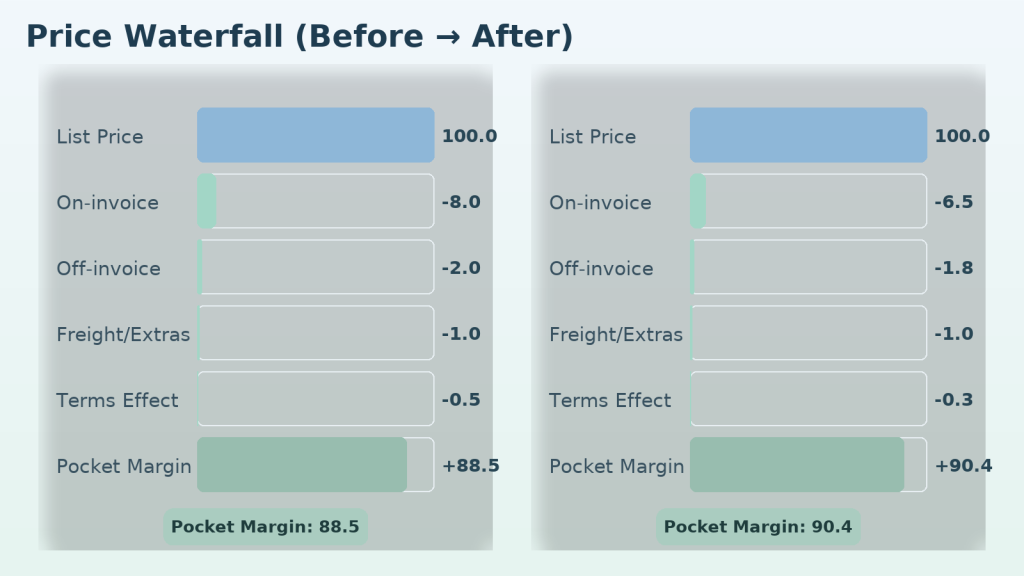
The core view inside the simulation is the price waterfall. It starts with list price and walks down through common “leaks”: on-invoice discounts, off-invoice rebates, freight, and payment terms. At the end of the steps, you reach the amount you actually keep per unit—the pocket margin. When teams see this simple picture, they stop guessing where value is lost. They can point to a step in the waterfall and say, “This is where we should act.”
Another key idea is price realization—how much of your intended price you really capture after all the leaks. The simulation makes price realization visible on every scenario. When realization improves, contribution margin improves, even when list price does not change. This helps teams move away from a “sell more at any cost” mindset and into “sell right, protect value.”
Why does this help in the real world? Because pricing problems are cross-functional. Sales pushes for wins, Finance protects margin and cash, Operations manages capacity and service. In the simulator, these groups see the same numbers and learn the same simple story: small changes in discounts, terms, and mix can lift margin more reliably than big, blunt price moves. With shared facts and a clear price waterfall, teams agree on guardrails and create a basic codebook—when to discount, when to upsell, and how to defend value with confidence.
From Revenue to Profitable Growth: The Mindset Shift
Growing revenue feels good. But if the margin behind that revenue is thin—or the cash comes in too late—growth becomes fragile. The shift we need is simple: sell in a way that protects value. A business simulation for pricing helps teams practice this shift in a safe space. Instead of pushing more units at deeper discounts, they learn how small, smart moves change the end result: better price realization, stronger contribution margin, and steadier cash.
What changes when the mindset changes?
- From volume-first to value-first. Winning a deal at any price is not a win. We protect pocket margin and only discount with a clear reason.
- From blanket discounts to targeted levers. We stop using one big lever for everything. We tune mix, terms, and offer design for each segment.
- From guesswork to shared numbers. Teams use the same simple visuals—the price waterfall and a margin bridge—to see where value leaks and how to fix it.
- From short-term spikes to steady, profitable growth. We prefer a repeatable approach that compounds results across quarters.
Three habits that build profitable growth
- Choose mix before discount.
If a product or segment has stronger economics, sell more of that mix first. A one-point mix upgrade often beats a two-point price cut. In a pricing simulation, you can try both moves and compare their effect on contribution margin side by side. - Trade price for terms only when it pays.
Sometimes a small discount is fine—if you get faster payment or a larger, firmer order in return. Use the waterfall view to see the full picture: list price → invoice price → off-invoice → freight → terms → pocket margin. If the cash benefit does not offset the value leak, do not trade. - Make discounts visible and rule-based.
Unseen, one-off discounts weaken price realization. Set simple guardrails: when to discount, how much, and who approves. The simulator helps teams test guardrails and see how they hold up across scenarios.
A simple daily checklist
- Did we propose the right volume–mix–price combination for this customer?
- Can we protect value with packaging, service level, or timing instead of a discount?
- If we discount, what do we get back—speed, size, commitment?
- After the deal, what happened to price realization and cash timing?
This is the heart of the mindset shift: make pricing choices that tell a clear value story and show a clean margin path. With a business simulation for pricing, Sales, Finance, and Operations rehearse these moves together. The result is not just more revenue; it is revenue that arrives with healthy margin and reliable cash—true profitable growth.
If you want a broader view of trade-offs and governance beyond pricing, explore Business Simulation for Strategic Decision-Making.
Price Waterfall Basics: From List Price to Pocket Margin
The price waterfall is a simple picture of how money “leaks” between your list price and what you actually keep. It helps teams see where value goes, one step at a time, so they can act on the right step instead of guessing. In a business simulation for pricing, you make a change—like a smaller discount or a different offer—and watch the waterfall reshape in seconds. That fast feedback makes pricing talks clear and calm.
Start at the top: List Price
This is the headline number. It is useful for positioning, but it is not the money you keep. If you focus only on list price, you may feel safe while margin quietly erodes below.
On-invoice discounts → Invoice Price
Here we subtract visible discounts (campaigns, tiered discounts, seasonal deals). Many companies live here—adding “just one more” discount to win the deal. The waterfall shows how each point you give away reduces the base you build on.
Off-invoice items → Net Price
These are credits and rebates paid later (quarterly bonus, marketing funds, returns). Because they are delayed, teams often ignore them during the deal. The price waterfall keeps them in view so you do not celebrate a win that will shrink next month.
Freight, packaging, service extras → Net Pocket Price
Delivery, rush handling, custom prep—small items that add up. If you do not price them, they quietly eat the deal. A pricing simulation lets you test different policies: charge a fair fee, bundle it, or redesign the offer.
Payment terms and leakage over time → Pocket Margin
Long payment terms can hurt cash and turn a good deal into a slow drain. While terms are not a “price” line, they affect the money you actually keep and when you keep it. In the simulator, you can see how a small price trade for faster payment changes the outcome. The final step—what is left after product costs—is your pocket margin.
How to read and use the waterfall
- Spot the biggest leak first; fix that before chasing list price changes.
- Replace blanket discounts with targeted moves (mix, service level, timing).
- Make rules visible: who can approve which discount, and what you get in return.
- Track price realization every week. If realization improves, margin improves—even when list price does not move.
The value of this tool is clarity. With one view, Sales, Finance, and Operations see the same story and agree on the same actions. The price waterfall turns complex pricing into simple steps, and the simulator shows which step matters most for protecting pocket margin.
For a deeper look at how pricing choices affect DSO, inventory, and cash, see Business Simulation for Working Capital.
Volume–Mix–Price (VMP) Made Simple
Volume–Mix–Price (VMP) is a clean way to explain why margin went up or down. It breaks the change into three parts: how many units you sold (volume), which products or customers you sold to (mix), and what you charged (price). In a business simulation for pricing, you can test each part one by one and see the result right away. This removes guesswork and stops the “it must be price” reflex that often leads to broad, risky discounts.
Volume is the number of units. More volume spreads fixed costs and can help, but it is not always good. If the extra units come with deep discounts or high service costs, margin can fall. Volume alone does not tell the story.
Mix is which products, segments, or channels you sell. A small shift toward higher-margin items or healthier segments can lift profit more than a big push for raw volume. Mix is often the quiet hero behind strong quarters.
Price is not just the list price. It is what you really keep after discounts and extras, which you can see in the price waterfall. When you track price realization each week, you learn whether your pricing rules protect value in real deals.
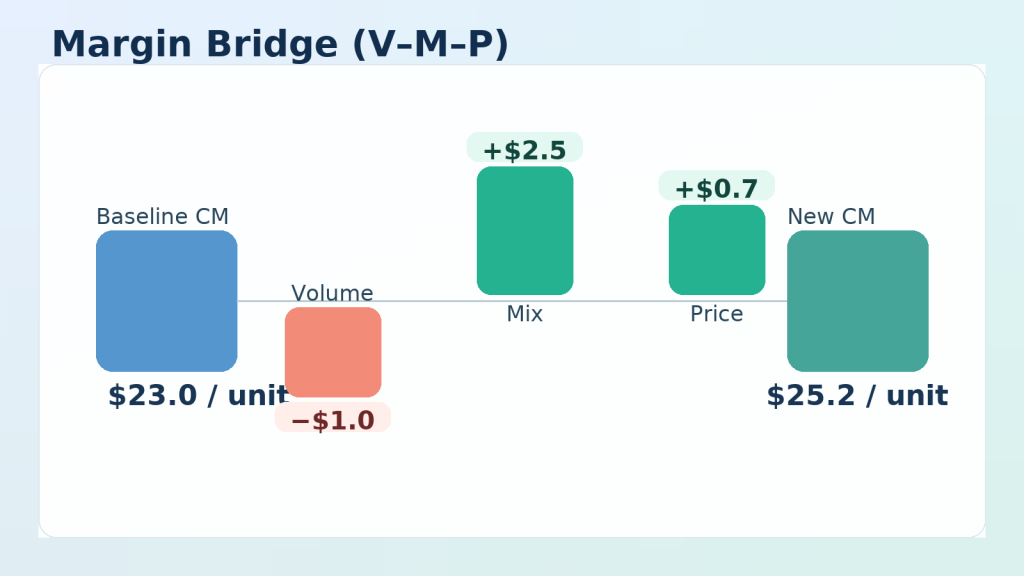
A simple way to read VMP is with a margin bridge. Start with last period’s contribution margin. Then show three blocks: the volume effect, the mix effect, and the price effect. Each block moves the bridge up or down. This picture helps Sales, Finance, and Operations talk in the same language and agree on where to act first.
How to use VMP in daily decisions
- When volume is weak, do not jump to broad discounts.
Try a mix nudge first: promote a higher-margin SKU or a better-fit segment. - When price pressure rises, tighten discount rules and make trade-offs visible.
If you must discount, ask for something back—faster payment, firmer forecast, or a larger, planned bundle. - When the quarter is good, learn why.
Was it volume, mix, or price? Lock in the behavior that actually lifted margin.
Try it in the simulator
- Run a pricing simulation with three turns:
- push volume with a broad discount,
- push mix with a targeted offer,
- hold list price but improve price realization with cleaner approval rules.
- Compare the margin bridge across these runs.
- Check the end state in pocket margin and cash timing.
The lesson is simple: price is not the only lever. With VMP, you make small, precise moves that protect value. Used with the price waterfall, this lens shows how business simulation for pricing turns teams away from blunt cuts and toward clear, profitable growth.
To strengthen the finance basics behind these ideas, visit Business Simulation for Business Acumen.
Running a Pricing Scenario: Discounts, Terms, and Mix
A business simulation for pricing lets you try real moves without risk and see the result in minutes. Here is a simple, repeatable flow you can use with your team. It keeps the focus on three levers you control every day: discounts, payment terms, and product/customer mix. The goal is clear—lift price realization, protect pocket margin, and keep cash healthy.
Step 1 — Set a clean baseline
Pick one product family and one segment. Load today’s list price, average discount, typical rebates, freight policy, and payment terms. Confirm costs and service levels. This baseline is your “current policy.” In the pricing simulation, run it once and capture the dashboard: revenue, contribution margin, price waterfall, and cash timing.
Step 2 — Test a discount change (but keep it small)
Reduce the average discount by 1–2 points, not more. Re-run the scenario.
Look at the price waterfall: did the on-invoice step shrink as expected? Check win rate and volume—did you lose more units than you gained in margin? If the tradeoff still lifts pocket margin, keep it. If not, undo it and try a different move.
Step 3 — Trade price for terms only when it pays
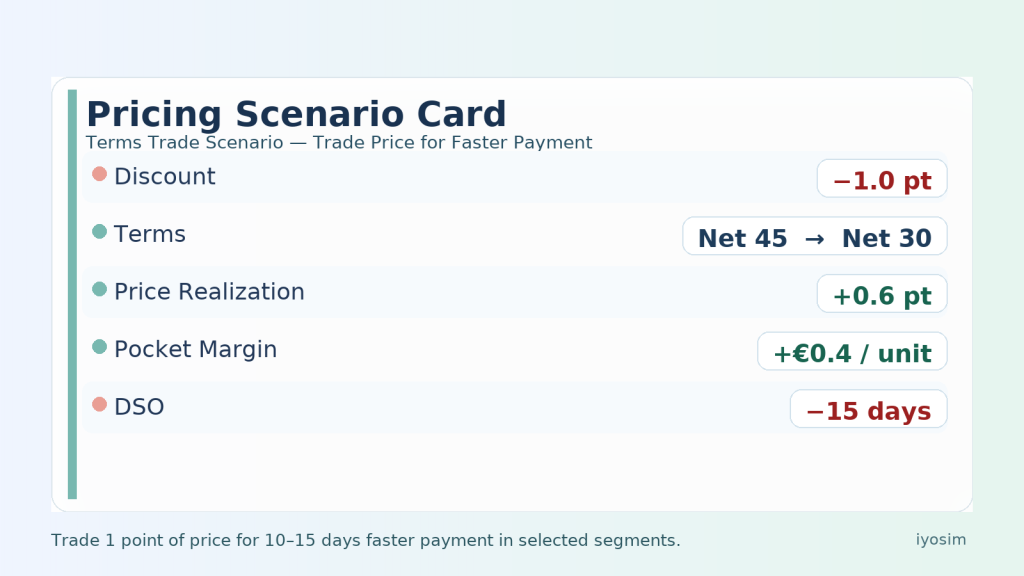
Offer a small discount in return for faster payment (for example, net 45 → net 30). Re-run. On the dashboard, compare contribution margin and the cash view. If cash improves and margin stays stable or better, this is a good trade. If margin drops and cash barely moves, reject it. Write a simple rule: “We only trade 1 point of price for 10–15 days faster payment in segments A and B.”
Step 4 — Nudge the mix before cutting price
Promote a higher-margin SKU or a healthier segment. Keep list price and discount rules as in Step 2. Re-run. The margin bridge should show a positive “mix” block even if volume is flat. This is often the cleanest way to lift profit without training customers to wait for discounts.
Step 5 — Make discounts visible and rule-based
In the simulator, enforce a clear ladder (for example: 0–3% by rep, 3–6% by manager, 6%+ by director). Run three back-to-back quarters with this ladder on. Track weekly price realization and average pocket margin. Most teams see a steady lift with fewer “special cases.”
How to read the results (quick checklist)
- Did price realization rise vs. baseline?
- Which step in the price waterfall shrank most? (on-invoice, off-invoice, freight)
- Did contribution margin per unit improve, even if volume was flat?
- Did cash timing improve when terms changed?
- Which move—discount, terms, or mix—created the best gain with the least risk?
Run this cycle a few times. The pricing simulation will show a clear pattern: small, targeted changes in discounts, smarter terms, and a better mix usually beat broad price cuts. Lock those patterns into your playbook and scale them with confidence.
Reading the Results: Price Realization and Contribution Margin
When you finish a run in the pricing simulation, start with two simple questions:
- Did price realization go up?
- Did contribution margin per unit improve?
If both are true, you likely made a good move—even if total volume did not jump. Here is a clear way to read the dashboard without getting lost in details.
1) Track price realization first
Price realization shows how much of your intended price you actually capture after leaks. Compare it to your baseline:
- Open the price waterfall and look for the shrinking step (on-invoice discount, off-invoice rebate, freight, extras).
- If realization improved with no damage to win rate, you protected value. Keep that rule.
- If realization improved but volume collapsed, try a lighter change or a mix nudge instead of a price cut.
2) Confirm contribution margin next
Contribution margin per unit tells you whether the deal pays for itself. Read it alongside realization:
- If realization ↑ and contribution margin ↑, great—this is value you keep.
- If realization ↑ but contribution margin flat, check costs or service extras; maybe you gave away value in packaging or delivery.
- If contribution margin ↑ while realization flat, your mix likely improved (higher-margin SKUs or better segments).
3) Use the margin bridge for a clean story
Open the margin bridge and separate the change into Volume–Mix–Price (VMP):
- Price block should move up when price realization rises.
- Mix block shows whether you sold more profitable items or segments.
- Volume block helps you avoid “won the deal, lost the margin” traps.
This single picture lets Sales, Finance, and Operations agree on what actually worked.
4) Read cash effects quickly
Better terms can turn a small price trade into a real win. Check the cash view: did DSO improve? If you traded 1 point of price for 15 days faster payment and pocket margin stayed healthy, you improved both margin quality and cash timing.
5) A tiny example (for intuition)
Baseline: price realization 91%, contribution margin €23/unit.
Scenario: tighter discount ladder and small mix upgrade → realization 92.2%, margin €25.2/unit, volume flat.
Result: no fireworks, just steady, profitable growth. That is the kind of win you want to repeat.
6) Make it a weekly habit
- Review price realization, contribution margin, and the price waterfall every week.
- Log which rule change moved which step.
- Keep the rules that lift realization without heavy volume loss; drop the rest.
With a business simulation for pricing, you do not guess. You read a few simple visuals, tie them to pocket margin and cash, and keep only the moves that prove they work. That is how pricing turns from noise into a repeatable, value-protecting system.
For clear dashboards, margin bridges, and price waterfall visuals, see Business Simulation: Data Visualization.
What to Do Next: Simple Steps to Apply in Your Team
You do not need a big project to start. Pick one product family, one segment, and run a short session. Keep the first cycle simple and focused on value. Here is a clear plan you can use tomorrow.
1) Set up a quick pilot (2 hours)
- Define the goal in one line: “Lift price realization by 1 point without losing healthy volume.”
- Gather today’s facts: list price, average discount, rebates, freight, payment terms, cost per unit.
- Load these into a business simulation for pricing as your baseline. Save the dashboard.
2) Create a short rulebook (one page)
- Discount ladder: who can approve 0–3%, 3–6%, 6%+.
- Trade rule: only trade 1 point of price for 10–15 days faster payment in selected segments.
- Mix nudge: name two higher-margin SKUs to promote first.
Keep it short. Your team should be able to explain it in one minute.
3) Run three quick scenarios
- Scenario A (discount trim): reduce average discount by 1–2 points; read the price waterfall and pocket margin.
- Scenario B (terms trade): offer a small discount for faster payment; check cash timing alongside margin.
- Scenario C (mix push): promote a higher-margin SKU or a better-fit segment; check contribution margin with volume flat.
Pick the scenario that gives the cleanest gain with the least risk.
4) Turn the win into a weekly ritual
Every week, review three items with one chart each:
- Price realization trend (did the line tick up?).
- Price waterfall (which step shrank?).
- Margin bridge using volume–mix–price (what really drove the change?).
If a rule lifts realization without heavy volume loss, keep it. If not, remove it.
5) Coach the field with simple cues
- “Mix before discount.”
- “If we discount, what do we get back?” (speed, size, commitment)
- “Charge fairly for extras or redesign the offer.”
- “Protect pocket margin; tell the value story first.”
6) Standardize the artifacts
- One-page pricing codebook (ladder, trades, mix list).
- Before/after pack: price waterfall and margin bridge screenshots.
- Short FAQ for reps and managers: when to discount, when to upsell, how to explain terms.
7) Expand carefully
After two or three steady weeks, add one more segment or product family. Keep the same rhythm. The pricing simulation is your safe place to test ideas first and bring only proven rules into real deals.
Start small, learn fast, and protect value. With a steady cadence and a clear view of price realization, contribution margin, and pocket margin, your team will move from “sell more” to “sell smart”—and build reliable, profitable growth.
Conclusion
Pricing gets clear when everyone sees the same picture. A business simulation for pricing lets your team test real choices—discounts, terms, and mix—and read the impact in minutes. With simple visuals like the price waterfall, you spot leaks. With price realization, you see if your rules protect value. With pocket margin and contribution margin, you learn what you actually keep. The result is steady, profitable growth without guesswork or risky experiments in the market.
If you take one idea forward, make it this: start small, learn fast, and keep the wins. Use a short rulebook, track a few metrics each week, and adjust only what the data supports. When Sales, Finance, and Operations practice together in a pricing simulation, they build the same story and the same habits—sell the right mix, discount with purpose, and trade price for real benefits. Ready to see it in action? Book a 30-minute walkthrough and explore how business simulation for pricing can lift your next quarter’s results.

