How to run a business simulation workshop: a facilitator's guide
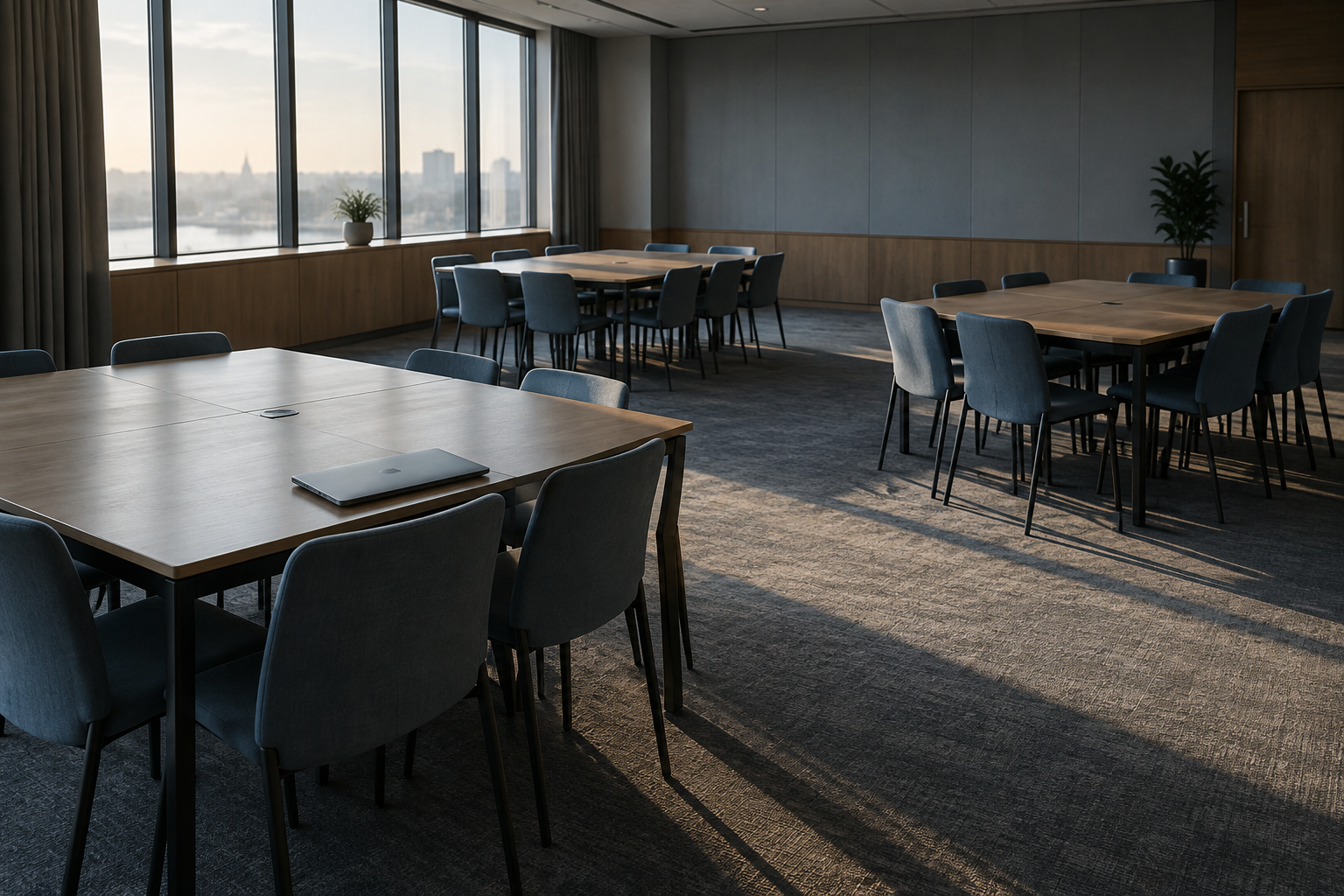
A facilitator usually arrives before anyone else. The room is quiet, the chairs are still in rows from the last meeting, and the laptops are closed on a trolley by the door. By the time the first participant walks in, the tables need to be in islands, the platform needs to be open and tested, and the facilitator needs to know, almost by instinct, how the next few hours will unfold. Running a workshop around Executive 2.0, İYOSİM's business management simulation, is as much about pacing a room as it is about the simulation itself.
This guide sets out what that pacing looks like in practice, from the week before the session to the moment participants leave. It covers preparing the scenario and the accounts, setting up the room, opening the first round, running the loop that repeats through the day, debriefing the results, and the format choices and pitfalls that shape how smoothly the whole thing goes.
Before the room: preparing the scenario and the accounts
The first decisions are made long before anyone sits down. A facilitator chooses between a ready-made industry scenario and a scenario adapted to the client's own sector, which is included in the license at no extra cost. Executive 2.0 runs the same underlying loop in either case, so the choice is about relevance to the audience, not about the mechanics of the session.
The number of accounts follows from the group. Each account is one login, used by one participant or by one team, and a minimum of three accounts is required because the companies compete in the same market. Six teams of three, for example, use six accounts, and teams of three are recommended for the quality of discussion they produce, though not required.
Facilitator training is part of the simulation usage license and covers setting up, running, and debriefing sessions. It is worth returning to those notes the week before a workshop, particularly the admin controls for assigning accounts, starting and pausing rounds, and moving between rounds, since fluency with these controls is what lets a facilitator focus on the room rather than the platform during the session itself.
Setting up the room for a simulation workshop
Rows of chairs facing a screen do not work for this kind of session. Teams need to talk to each other constantly, lean over a shared laptop, and occasionally turn to glance at what another team seems to be doing, so tables pushed into islands, one per team, with enough space between islands to limit overheard conversations, serve the day far better.
Every island needs a laptop that can reach the platform reliably, and it is worth testing this before participants arrive rather than during the first round. The platform itself is fully in English, which matters when confirming that every device and login works as expected rather than discovering a problem once a team is mid-decision.
The shape of the day also needs a visible structure, whether that is written on a flipchart or simply held in the facilitator's own running order. Participants settle faster when they can see that decisions, results, and discussion will alternate in a predictable rhythm, rather than wondering how long the next stretch will last.
How many rounds should a one-day workshop have?
Up to four rounds fit comfortably into one training day, as a rough guide, with the related guidance being that four rounds suit a one-day programme, six rounds a two-day programme, and eight rounds a two- or three-day programme. These figures are a starting point for planning, not a fixed rule for every group.
The right number for a given day still depends on what the facilitator wants participants to experience. Three rounds already show the shift from plan to actual and back again, while four leaves room for a fuller debrief after the final round without rushing the close of the day.
Opening the session: the first round
The opening minutes matter more than they seem to. Before any decision is made, participants need a plain description of the loop they are about to repeat: review where the company and the market stand, set the next decisions, see the actual results once competitors and the market have had their effect, and then decide again with that comparison in hand.
Once the loop is clear, the first round's decisions tend to move slowly. Teams are still finding their footing with each other, working out who leans towards caution and who wants to move fast, and checking the expected effect of a decision before confirming it rather than relying on instinct alone.
That slowness is normal and worth naming out loud. A facilitator who tells teams that the first round is for getting oriented, not for getting it right, takes some of the pressure off a moment that otherwise makes people reluctant to commit to a decision at all.
Running the loop round after round
From the second round onward, the rhythm becomes familiar: review, decide, see the actual results, compare, decide again. What changes is that every round now carries the weight of the rounds before it, since the same company is managed across the whole session and earlier choices shape what is possible later.
This is where plan versus actual becomes visible in a way that a slide on budgeting never quite manages. A team sees the effect it expected from a decision before the round runs, then meets the actual outcome once competitors and the market have done their part, and the gap between the two, when there is one, tends to generate more discussion than the plan ever did on its own.
The facilitator's job during these rounds is mostly to keep time and keep the loop moving, pausing between rounds so that teams can absorb results rather than rushing straight into the next set of decisions. Moving between rounds is a deliberate control, not an automatic flip, and using that pause well is often what separates a workshop that lands from one that simply runs to schedule.
What happens when a team's plan meets the actual results?
The actual results depend on what every other company in the market did as well, so a plan that looked sound on paper can still land differently once the round completes. There is no single right strategy to discover, which is often the point that lands hardest with participants who expected the simulation to reveal a correct answer.
A team that grew too fast, chasing a market position before building the resources to support it, will usually see that tension show up clearly in its own results rather than needing the facilitator to explain it. The facilitator's role in that moment is to let the result register before asking the team to describe, in their own words, what they now understand that they did not before the round ran.
Handling the competitive dynamic between teams
Every company in the session sits in the same market as every other, so one team's commercial push affects what is left for the rest. Participants have the information they need for each decision, but they cannot know for certain how it will land once every other team's choices are added to the picture.
Full company and market results are available after every round, which gives teams a genuine basis for comparing their position against the others rather than guessing at it. A facilitator can use that moment, briefly, to let teams see where they stand before moving into the next round's decisions.
It is worth resisting the temptation to turn this into theatre. The competitive structure exists to make decisions matter and to remove any single correct path through the scenario, not to crown a winner, and a facilitator who keeps the emphasis on what each team is learning from its own numbers gets more out of the day than one who dwells on the leaderboard.
Debriefing: turning results into learning
A workshop without a debrief is simply an afternoon spent making decisions, and most of the value the simulation can offer sits in the conversation that comes afterwards, not in the rounds themselves. The debrief is where a team's choices, results, and reasoning get put into words that can travel beyond the room.
Open questions work better than closed ones here. Asking a team what they would do differently if the session continued, or what the results suggest about how they were reading the market, tends to produce more useful reflection than simply asking whether they are satisfied with their standing.
It also helps to connect the debrief back to the loop itself, asking teams to trace a specific decision through to the result it produced rather than discussing performance in the abstract. That link between a concrete choice and a concrete outcome is usually the clearest evidence participants take away that the exercise reflected real management trade-offs.
How should a facilitator handle a team that falls behind early?
The first move is to treat the gap as information about the market and the decisions made, not as a verdict on the people in the team. A company's results in the simulation belong to the team that made the decisions together, and the facilitator's language in the room should reflect that throughout.
Falling behind early often becomes the most instructive position in the room, because the team has to decide whether to correct course, double down, or try something different with the rounds still ahead. A facilitator who treats this as a live decision to explore, rather than a problem to console a team about, usually finds the team re-engages faster than one that is quietly reassured and left to coast.
Running the workshop online, face to face, or across multiple days
Executive 2.0 can be run online or face to face, with the choice set by the organisation's own conditions and the design of the programme rather than by any constraint in the simulation. A facilitator planning a session should treat the format as a design decision made early, not an afterthought fitted around whatever room or platform happens to be available on the day.
Longer programmes follow the same rough guide used for single days: six rounds suit a two-day programme and eight rounds suit a two- or three-day programme, spreading the rounds out to allow for reflection between sessions rather than compressing everything into one sitting. Multi-day formats also give a facilitator room to set small preparatory tasks between sessions, building anticipation for the next set of results.
Facilitator admin access works the same way regardless of format, letting a facilitator start, pause, and stop the simulation and move between rounds on their own schedule. That consistency is part of what makes it practical to run the same scenario as a single intensive day for one group and as a spread-out programme for another.
Common pitfalls to avoid as a facilitator
The most common mistake is rushing through results to protect time for the next round. Teams need a genuine pause to read their own numbers before being asked to decide again, and a facilitator who compresses that pause to stay on schedule usually ends up with decisions made on instinct rather than on the results in front of the team.
A second pitfall is skipping or shortening the debrief when a day runs long. Since the debrief is where most of the learning actually gets named and kept, protecting that time matters more than squeezing in one more round, and it is almost always better to run one fewer round than to run the debrief badly.
A third is treating the workshop as a single, self-contained event rather than part of a broader programme. Participants carry more from a session when a facilitator connects it explicitly to the training or development objectives it was designed to serve, rather than letting it stand alone as a one-off exercise.
Building a repeatable workshop around Executive 2.0
Once a format has settled, running it again is mostly a matter of reusing what already works. The scenario stays available, the facilitator admin access works the same way every time, and the accounts can be reassigned to a new group without rebuilding the session from scratch.
Your accounts, your sessions, your schedule.
That is the practical shape of the license: a facilitator is not waiting on anyone else to open a session, close it, or hand over results. Each run through the loop becomes a little more fluent, both for the facilitator running it and for the organisation deciding how to use it next.
A licensee that wants to put this guide into practice, or wants to talk through how a particular group or scenario might work, can get a license quote and take the conversation from there.
İYOSİM. This article was prepared from a topic plan set by the İYOSİM team and İYOSİM's product information on Executive 2.0.